

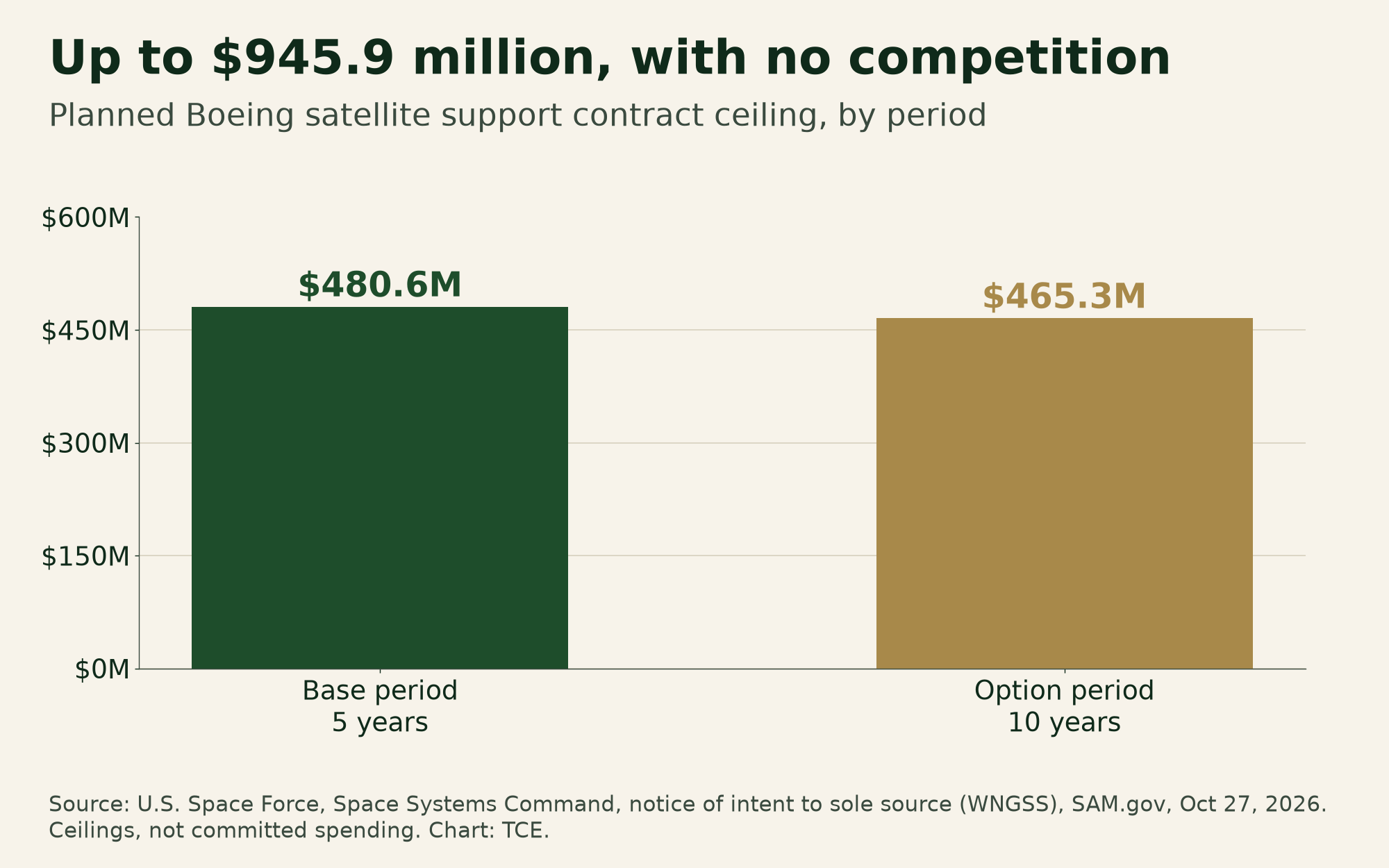
The Space Force plans to give Boeing up to $945.9 million over as long as 15 years to keep two military satellite fleets running, and it says it can't run a competition for the work. The reason isn't price or performance. It's a decision made years ago about who owns the design data.
The notice
On Oct 27, Space Systems Command posted a notice on SAM.gov, the federal contracting site, saying it intends to award Boeing a sole-source contract for Wideband and Narrowband Global Satellite Communications (SATCOM) Sustainment. The work covers the Wideband Global SATCOM (WGS) satellites and the Ultra High Frequency Follow-On (UFO) satellites. Boeing would provide round-the-clock analysis when something goes wrong in orbit, factory engineering support, collision avoidance, end-of-life disposal, ground system support and flight software.
The deal is an indefinite delivery, indefinite quantity (IDIQ) contract: a spending ceiling, with orders placed as needed. It has a five-year base worth up to $480.6 million and one 10-year option worth up to $465.3 million.
The mechanism
The notice is direct. The government "does not possess sufficient data license rights" to the technical data packages, flight software source code or high-fidelity satellite simulators that another company would need to bid. That data covers Boeing's 702HP and 702MP satellite platforms, which the notice says were "developed at private expense." It adds that "Boeing has repeatedly declined the Government's requests to sell the necessary data rights."
 Click to enlarge
Under defense contracting rules, when a company develops an item with its own money, the government generally gets only limited rights to the technical data. It can use the data in house, but it usually can't hand it to a competitor. Without the drawings, code and simulators, a rival would have to rebuild that knowledge from scratch. The notice says that would mean "substantial duplication of cost" and "unacceptable delays and risk to on-orbit assets."
So the competition for this support work was settled when the satellites were bought, not this year. The data rights agreed at the start of a program decide who can bid on the aftermarket for as long as the hardware flies.
The trade-off
For buyers, data rights are an upfront cost that's easy to cut. Paying for the rights, or for designs built around open interfaces, raises the price of the first satellite. Skipping that cost can turn every year of support after launch into a negotiation with one supplier.
 Click to enlarge
For sellers, the math runs the other way. A company that funds a platform itself has a fair claim to the design. Keeping the data protects that investment and turns a hardware sale into years of service work that competitors can't easily reach. Selling the rights would trade that steady work for a one-time payment.
Both choices make sense when they're made. The cost shows up later, when the buyer has no fallback and the seller has no reason to sell.
What comes next
Companies that think they can do the work have until Nov 17 to say so. No award has been made. Boeing and the Space Force declined to comment to Washington Technology.
The lesson applies to anyone buying long-lived equipment, from satellites to factory lines. Settle who owns the data before signing for the hardware. After launch, the price of that choice is already set.
Sources
- Space Systems Command, notice of intent to sole source, Wideband and Narrowband Global SATCOM Sustainment (WNGSS), notice 26-18, SAM.gov, posted Oct 27, 2026. https://sam.gov/workspace/contract/opp/056ad9c020c74faeb89ec3eb16bb3309/view
- Defense Federal Acquisition Regulation Supplement 252.227-7013, Rights in Technical Data, Other Than Commercial Products and Commercial Services. https://www.acquisition.gov/dfars/252.227-7013-rights-technical-data%E2%80%94other-commercial-products-and-commercial-services
- Washington Technology, Nick Wakeman, Oct 30, 2026.