
For a long time I thought real rock and roll needed a big 50 watt tube amp. That was the dream. A half stack, loud enough to feel in your chest, the thick sound you hear on the records. Anything smaller felt like a compromise.
It turns out you can get a lot done without one. These days I play through a Yamaha THR10X, the olive green high gain version of Yamaha's little desktop modeler. It's 10 watts, sits on a shelf and still gets me the heavy, saturated sound I used to think required a wall of tubes.
Bigger modelers like the Neural DSP Quad Cortex, the Line 6 Helix and the Kemper go a lot further. Plenty of players never haul a tube head anywhere anymore.
That's why the new PRS Tekton caught my eye.
What PRS just released
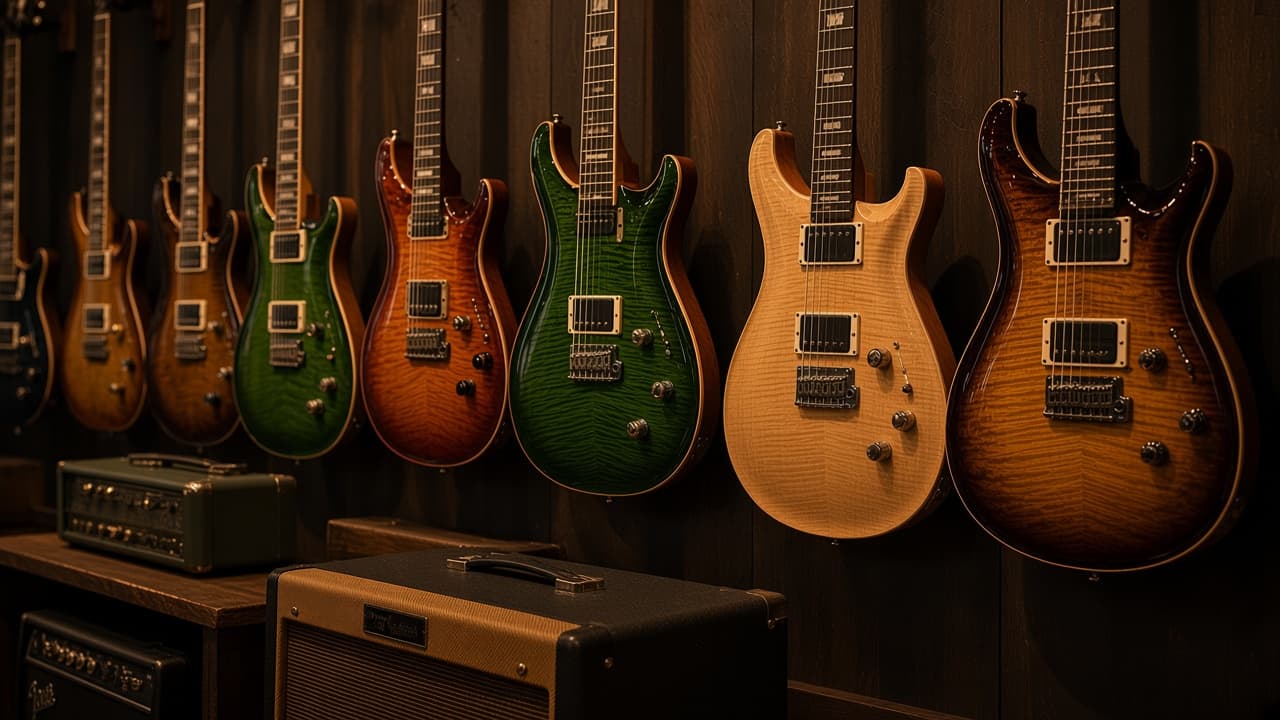
PRS announced the Tekton on October 20, 2026. It's a family of four bolt-on guitars built in Stevensville, Maryland. The Tekton has a hardtail, the Tekton T has the PRS two-point tremolo, the Tekton "Floyd" has a Floyd Rose and an alder body, and the Tekton SVN is a seven-string. The Tekton and Tekton T are $2,899 and the Floyd and SVN are $2,999, gig bag included.
The specs are built for fast, technical playing. A 25.5 inch scale on the six-strings and 26.5 on the seven, a flat 16 inch radius, stainless steel frets, and what PRS calls the thinnest body and neck it has ever made in standard production.
The interesting part is the pickups. PRS designed a new humbucker for the family called Stylus, and gave it "a flatter output than many other humbuckers to keep some character while catering more to digital gear." The company says it kept the output deliberately lower than a lot of heavy pickups because that "should pair with digital rigs better." It makes sense. If the modeler is handling the amp and the gain, the guitar doesn't need to shove a ton of its own color in front of it.
PRS says it works with tube amps too, so it isn't a modeler-only guitar. But it's pretty clear who they had in mind.
PRS Guitars
A little about PRS
Paul Reed Smith opened his first factory in Annapolis in 1985 and moved the company across the Bay to Stevensville on Kent Island in 1996. It's still privately held, with more than 500 people in Maryland, and it turns out roughly 100 guitars a day.
The lineup runs in tiers. Private Stock, Core, Bolt-On and S2 guitars are built in Maryland. The more affordable SE line is built by a partner in Indonesia, with SE acoustics and hollowbodies made in China. Tekton sits in the American Bolt-On family, next to John Mayer's Silver Sky, and borrows its string spacing.
The players
PRS has always been tied to its artists. Carlos Santana was the first signature player. Mark Tremonti became the second in 2000, and for me that's where PRS really lives.
Alter Bridge is a big part of why I care about this company. Tremonti's guitars have been a staple for heavy rock players for more than two decades. Then in 2023 PRS gave Myles Kennedy his first signature model, a T-style swamp ash guitar with a pair of Narrowfield pickups, and it was a different animal from anything Tremonti plays. Kennedy said he tracked about 80 percent of his electric parts on Pawns & Kings with it. Having both guys from the same band on PRS signature guitars meant something to me.
Kennedy also said in PRS's launch video that he used to work at a music store, and if someone had told him back then he'd have his own signature model, he wouldn't have believed it. Having worked the floor at Guitar Center, that one landed with me.
Mark Holcomb of Periphery has a popular signature SE model, and its 2023 update shipped with Seymour Duncan pickups designed with modeling amps in mind. Tekton feels like that idea grown up into a full American line, with its own pickup and no single artist's name on it.
PRS Guitars
The shift
The numbers back up what I've noticed. Reverb said most of its best selling amps in 2025 were modelers, led by the Quad Cortex and the Helix. Traditional heads and combos still outsold modelers four to one on its platform overall, so the tube amp isn't going anywhere. But the direction is clear enough that a builder like PRS designed a whole family of guitars around it.
I still love a loud tube amp. I just don't think you need one anymore to sound like you mean it.