

The Textbook We're Living In.
Defense spending is reshaping the US economy along Keynesian textbook lines. Where the 2026 surge is landing — and which chapter comes next.
There is a peculiar feeling when the material you studied in a classroom begins to appear outside your window.
Every economics student spends time with the same core apparatus: aggregate demand curves, the Keynesian multiplier, the post-WWII playbook. At the time, it all feels theoretical. Then the news in 2026 begins to look exactly like those diagrams. The surge in military spending, the activation underway across the country, the reopening of forging and heat-treat capacity that had been idle for thirty years — none of it is unprecedented. It is textbook.
The interesting question is not whether we are in a wartime economy. We are. The interesting questions are: which chapter are we in, which chapter comes next, and where, physically, is the surge actually landing?
The frame, in three figures.

The Keynesian frame.
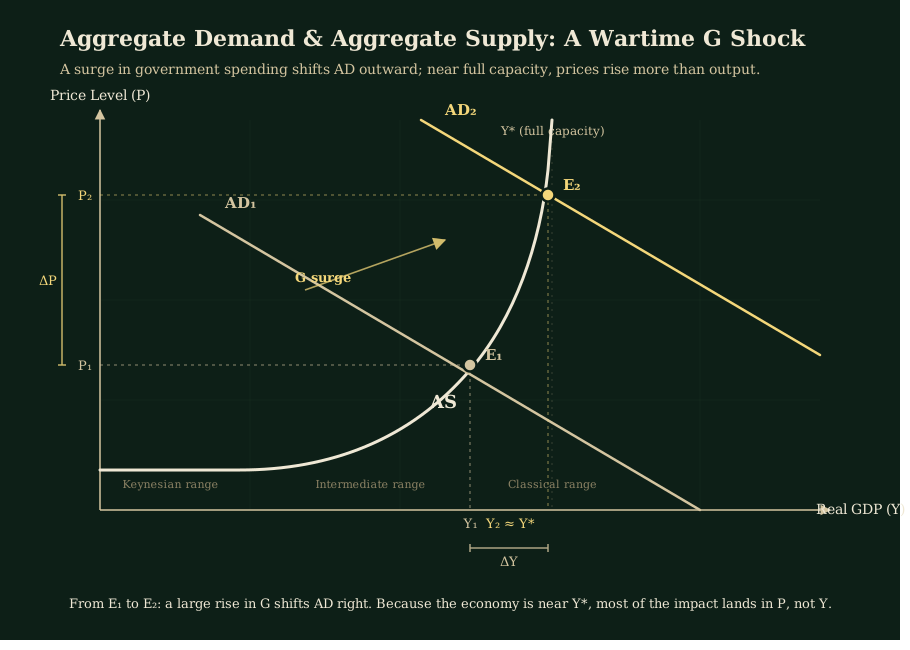
Aggregate demand breaks into four parts: consumer spending, private investment, government spending, and net exports. AD = C + I + G + (X − M).
In normal times these are roughly balanced. In wartime, G becomes the decisive force. Munitions contracts, shipyard activation, weapons production ramp-ups, procurement accelerations — all land heavily in G, and the spending multiplies through the rest of the economy. A $100B surge in military spending can generate something closer to $500B in total economic activity as it cascades through primes, sub-tiers, distributors, workforce, and local economies.
You can print money. You cannot print a forging slot. Heat-treat furnaces have lead times of 12 to 18 months. Certified machine shops take years to qualify. Specialty alloys require producers, distributors, and a trained workforce that has been shrinking for three decades.
Aggregate Demand & Aggregate Supply: a wartime G shock.
A surge in government spending shifts AD outward. Near full capacity, most of the impact lands in prices, not output.

Where the surge actually lands.
Public discussion about defense spending usually focuses on the visible layer — Pentagon contract announcements, SAM.gov bids, headline dollar figures. Activation happens underneath, well below the Primes.
When a prime announces a production ramp, the binding constraint is almost never the prime itself. The constraints are in tiers two, three, and four — forging slots, heat-treat lines, certified machine shops, NDT labs, specialty metals distributors, authorized electronic component distributors operating under AS6081 protocols. These businesses are often regional, privately held, and largely invisible to public markets.
They are also where the physical economy lives. Mapped geographically, the activation lights up in specific places.
Six regions absorbing the sub-tier surge.
Each region has a distinct industrial competency carrying the activation. The dollars flow through specific addresses, not abstractions.

Three chapters, and the one we are in.
History gives three post-wartime economic templates. Each is a real case. The forward question is which one we end up writing.
The honest read is that we are still in the early stages of this surge — the ramp-up phase where new capacity is being activated and production is scaling quickly. The trajectory toward Chapter A, B, or C is not yet determined. It will largely be shaped by financing decisions over the next 12 to 24 months, and by whether the newly activated industrial base is preserved and strengthened, or allowed to shrink once the immediate demand eases.
The single most important variable is not the total amount of spending. It is the depth of absorption — how much of this surge translates into real, lasting capacity expansion versus temporary throughput.
Where this ends — three historical templates.
Smooth Demobilization
Pent-up consumer demand absorbs industrial capacity as it converts. GDP stays elevated. The activated sub-tier base is preserved. Post-WWII playbook.
Recessionary Contraction
Defense spending is cut faster than civilian demand can replace it. A sharp adjustment follows — concentrated in the regions and sub-tier suppliers that expanded most. Post-Korea and post-Vietnam templates.
Debt and Inflation Overhang
The surge is paid for too aggressively without enough real capacity created underneath. Stubborn inflation, weaker dollar, debt service crowds out future investment. The 1970s.

What this means for us.
The typical view of a defense surge often stops at the big prime contractors and headline contract values. But the full industrial value chain runs much deeper. The primes themselves rely on an extensive sub-tier network — the specialized manufacturers, machine shops, forging operations, distributors, and technical facilities that turn contracts into actual delivered hardware.
That is the layer we're continuing to focus on at TCE as client demand for this kind of intelligence grows.
Of the three questions we started with, only one has a clear answer. We know where the surge is landing — the sub-tier geography is visible and identifiable on the ground right now. Which chapter we're in, and which chapter comes next, are genuinely open. The ramp-up has barely begun. The financing choices haven't been made. Whether this activation hardens into lasting capacity or dissipates as temporary throughput is unresolved.
The textbook is playing out, but we are still on page one.
Want on-the-ground intelligence from the industrial base?
TCE sources operators inside the sub-tier — forge shops, heat-treat lines, certified machining, specialty alloy distributors. If you need that read, get in touch.