Skip to content
← All Articles

blog

Branded-Title Vehicles: Inside a Supply Chain Most People Have Never Heard Of

The Continental Exchange|March 9, 2026
Branded-Title Vehicles: Inside a Supply Chain Most People Have Never Heard Of

# Branded-Title Vehicles: Inside a Supply Chain Most People Have Never Heard Of

*What 6 Expert Calls Revealed About a Market Moving 1 Million+ Units Per Year*

---

We ran six expert calls to map a supply chain that most people outside the automotive industry have never thought about: the path from insurance total-loss vehicle to rebuilt, retitled, resold car.

The ecosystem is more sophisticated than it sounds. It's also bigger than most estimates suggest, with one expert telling us that branded-title retail sales may exceed one million units per year in the United States — a market sitting in plain sight that most automotive industry coverage treats as a rounding error.

Here's what we learned.

---

What "Branded Title" Actually Means

When a vehicle is in an accident, flood, or other event severe enough that the repair cost exceeds the vehicle's value, the insurance carrier typically declares it a total loss, pays out the claim, and takes ownership of the vehicle. The car then carries a "branded" or "salvage" title — a disclosure marking that this vehicle has been through a significant loss event.

Most of those vehicles don't get scrapped. They flow through a supply chain that includes:

**Insurance carriers** — who need to dispose of total-loss vehicles efficiently. The two dominant channels are Copart and Insurance Auto Auction (IAA), which between them have effectively consolidated the salvage auction market. Multiple experts confirmed that one veteran rebuilder sources "100 percent" of his inventory through these two platforms after regional alternatives were systematically acquired over the past two decades.

**Rebuilders** — who buy salvage vehicles at auction, repair them to varying standards of quality, and either retail the finished product or wholesale it to branded-title dealers. Rebuilders range from single-operator shops moving 20 vehicles per month to multi-state operations with dedicated body shops and purchasing infrastructure.

**Auction houses** — serving both as the primary sourcing channel for rebuilders (Copart, IAA) and as a disposal channel for finished rebuilt vehicles (Manheim, Metro Auto Auction, specialty auction lanes).

**Dealers** — who retail branded-title vehicles to consumers. The most notable large-scale entrant in this space is a leading branded-title retail chain, which scaled from three or four stores to 27 dealerships during the tenure of one former operations leader we spoke with. The company's model — transparency about the branded-title status, a 250-point inspection program, and secured financing relationships — essentially pioneered large-scale branded-title retail.

**Consumers** — who access branded-title vehicles at prices typically $5,000-10,000 below equivalent clean-title comparables, accepting the disclosure history in exchange for the price difference.

---

The Numbers Are Larger Than Reported

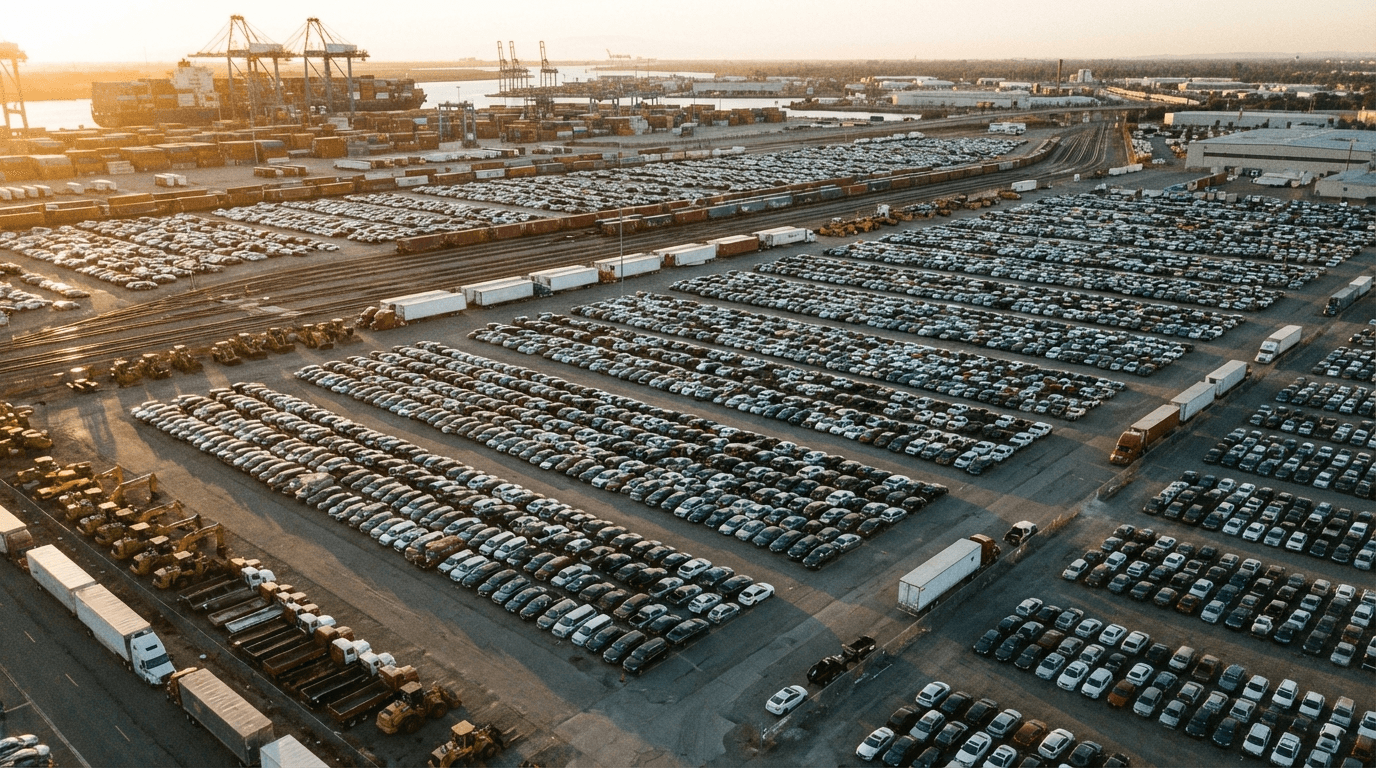
Roughly five million vehicles enter salvage auctions annually in the United States. About 20 percent of those are considered worth rebuilding, based on damage type, vehicle age, and repair economics. The remainder goes to dismantlers (who harvest parts), exporters, or scrap.

The one million branded-title retail sales figure came directly from expert conversation. Other estimates we heard: branded-title vehicles account for roughly one percent of U.S. used-car sales, with penetration slowly rising as consumer familiarity with the category grows and specialty dealers like AutoSavvy normalize the transparent retail model.

The export component is larger than most domestic market analyses acknowledge. One veteran rebuilder estimated the overseas share at roughly 20-25 percent of salvage auction volume — and potentially higher, since export buyers can often outbid U.S. rebuilders because their parts, labor, and import-duty economics are different. For newer, higher-value vehicles (2024-2026 models), the buyer mix at auction was described as roughly 40 percent rebuilders, 40 percent exporters, and 20 percent dismantlers. For older vehicles (2005 and earlier), dismantlers dominate.

---

How the Economics Work

A small-to-mid-size branded-title rebuilder like the operations we spoke with typically runs like this:

**Acquisition:** Buy at Copart or IAA, targeting vehicles with single-incident damage, typically collision or hail. Preferred inventory: late-model American trucks and SUVs (GM, Ford, select Dodge), finished price range $28,000-$55,000. Acquisition cost averages roughly 80 percent of equivalent clean-title value, per the price guidance that the leading branded-title retailer and similar wholesalers provide.

**Transport:** Central Dispatch moves vehicles from auction site to the rebuilder's facility. Transport cost runs approximately $0.60-$0.70 per mile per vehicle for long-haul moves.

**Repair:** Most small rebuilders contract body work to a neighboring shop and handle mechanical work in-house. A shop at 20-30 vehicles per month typically has three to five skilled technicians. The key process step is the inspection: rigorous operators use a 250-point checklist that specifically addresses flood versus collision damage, covers structural measurements (A/B/C-pillar checks), and verifies electronic components.

**Disposal:** Finished vehicles go to retail, wholesale, or auction depending on condition, demand, and cash flow needs. The leading branded-title retail chain, operating at roughly 1,200 units per month across 27 locations, is the dominant wholesale buyer — paying a reliable price, within days of title transfer, with predictable volume requirements.

Margins are meaningful when quality is maintained. They disappear quickly when rebuilders cut corners or take on vehicles that require more repair time than estimated.

---

The Competitive Landscape: AutoSavvy Dominates, But the Ecosystem Has Room

The leading branded-title retail chain is the clearest success story in branded-title retail at scale. Multiple experts described the company's combination of transparent pricing, financing infrastructure, and reconditioning standards as the model that "normalized" branded-title retail for consumers who might otherwise never have considered a salvage title vehicle.

One industry veteran's assessment was direct: "It's too late in the game for new entrants to overtake the current market leader. Even a combined effort by the remaining regional players might not match its position." The company built its advantage by mastering the two hardest parts of branded-title retail — securing financing relationships with lenders willing to fund branded-title purchases, and building consumer trust through transparency rather than obscuring the history.

But the overall ecosystem isn't winner-take-all. The supply side — rebuilders who source, repair, and wholesale vehicles — remains highly fragmented, with the constraint on scale being skilled labor and physical facility space more than vehicle supply. "There's always cars out there," as one rebuilder described it. The bottleneck is the technicians who can do the work correctly and the real estate to stage adequate inventory.

The auction market itself has become more competitive and, for professional rebuilders, more adversarial. Insurance carriers are setting reserve prices above Manheim Market Report values with increasing frequency. Inexperienced individual buyers and fee-based brokers without repair knowledge are inflating bids on desirable units. The expertise advantage that professional rebuilders once had — knowing which vehicles were worth buying and at what price — is being compressed by increased competition from buyers who don't carry the same quality discipline.

---

The Barriers Keeping Market Penetration at 1 Percent

Despite the economics and despite the quality that well-run rebuilders consistently deliver, branded-title vehicles remain at roughly one percent of U.S. used-car sales. The barriers are structural:

**Consumer stigma.** "Salvage" still triggers a negative reaction in most consumers who haven't been educated about what it means. The transparent retail model directly addresses this — showing the consumer the damage history, the repair documentation, and the inspection record — but that model is only deployed at scale by a handful of retailers.

**Financing access.** Most traditional auto lenders won't finance branded-title vehicles, or charge significantly higher rates. The leading retailer's early business breakthrough was convincing a Utah credit union to underwrite branded-title loans at full LTV — and once that model was proven, additional lenders including Capital One and Exeter were added. But financing remains a friction point that limits the buyer pool.

**Resale value uncertainty.** A branded-title vehicle will trade at a discount to clean-title equivalents for its entire resale life. Buyers who plan to sell within a few years absorb that discount at disposition. The value proposition is strongest for buyers who intend to hold the vehicle for multiple years — where the initial purchase discount outweighs the resale penalty over the full ownership period.

**Information asymmetry.** Most buyers don't know how to evaluate whether a rebuilt vehicle was repaired correctly. Without either a trusted brand (like AutoSavvy) or a qualified independent inspection, the quality uncertainty is real enough to justify the premium most consumers pay for a clean title.

---

What Makes This Market Worth Watching

The branded-title ecosystem is a useful case study in how supply chain efficiency and consumer education can gradually shift a market that looks constrained.

The drivers that could expand branded-title penetration from one percent toward something meaningfully higher:

- More transparency-focused retailers who combine transparent reconditioning standards with accessible financing - Digital inspection platforms (several exist; adoption is growing) that reduce quality uncertainty for private buyers - Rising new and used car prices that make the $5,000-10,000 branded-title discount relatively more compelling - A growing generation of buyers who research purchases thoroughly and are less susceptible to title-status stigma when the repair quality is documented

None of these are hypothetical — they're all in motion. The market one of our experts described as "slightly increasing" in consumer demand is probably underselling how the dynamics are pointing.

---

For PE investors in the automotive retail space, for insurance carriers thinking about disposition strategy, for technology companies building vehicle inspection or market intelligence tools — the branded-title supply chain rewards the effort of actually understanding it.

It's more sophisticated than it looks. The people running it are more knowledgeable than outside observers assume. And the market is bigger than most industry reports acknowledge.

Six expert calls told us a lot. The full picture would take more.

---

*This research was conducted for a leading strategy consulting firm as part of a branded-title auto retail ecosystem mapping engagement. TCE has conducted 24 Automotive and Fleet research engagements across a range of topics including fleet management, auto lending, branded-title vehicles, and EV charging infrastructure.*

*[contact@thecontinentalexchange.com] | [www.thecontinentalexchange.com]*

Need the right expert for your next engagement?

TCE is a precision expert network built for the searches that actually matter.

48-72h turnaround|Precision-matched sourcing|Compliance-first